"The Lord values those who fear Him, those who put their hope in His faithful love." I spend a lot of time around my house trying to teach my two toddlers to mind me. We still have a ways to go and I suspect that we will probably work on it through all their childhood and maybe through their teenage years as well!
Why do parents spend so much time, spend years, training their children to obey?
Is it because the parents want their children to be their little slaves?
Is it because parents want to feel powerful?
No! In fact, it's just the opposite. Parents want to empower their children to grow into well-adjusted people that understand the difference between right and wrong, between truth and lies, between good and evil, so that they can make right choices.
Sunday, April 22
Wednesday, February 29
Qualified for Membership - Acts 11:15-18
"As I began to speak, the Holy Spirit came down on them, just as on us at the beginning. Then I remembered the word of the Lord, how He said, 'John baptized with water, but you will be baptized with the Holy Spirit. Therefore, if God gave them the same gift that He also gave to us when we believed on the Lord Jesus Christ, how could I possibly hinder God? When they heard this they became silent. Then they glorified God, saying, 'So God has granted repentance resulting in life even to the Gentiles!'"
Citizenship is generally a function of where you are born. You are a citizen of the country in which you are geographically born or of which your parents are a citizen.
The same is true for citizenship in the Kingdom of God. Kingdom citizens must be born of God; they must be birthed by the Holy Spirit.
Jesus told Nicodemus this birth is appropriated by the Holy Spirit: "Unless someone is born of water and the Spirit, he cannot enter the kingdom of God" (John 3:6).
The apostolic Church recognized that it was the dispensing of the Spirit to people that constituted membership in the redeemed community of God. Receiving the Holy Spirit was the evidence that the Kingdom had come and of one's participation in it.
Citizenship is generally a function of where you are born. You are a citizen of the country in which you are geographically born or of which your parents are a citizen.
The same is true for citizenship in the Kingdom of God. Kingdom citizens must be born of God; they must be birthed by the Holy Spirit.
Jesus told Nicodemus this birth is appropriated by the Holy Spirit: "Unless someone is born of water and the Spirit, he cannot enter the kingdom of God" (John 3:6).
The apostolic Church recognized that it was the dispensing of the Spirit to people that constituted membership in the redeemed community of God. Receiving the Holy Spirit was the evidence that the Kingdom had come and of one's participation in it.
Sunday, February 26
Doing What God Does - Exodus 17:10-16
"Joshua did as Moses had told him, and fought against Amalek, while Moses, Aaron, and Hur went up to the top of the hill. While Moses held up his hand, Israel prevailed, but whenever he put his hand down, Amalek prevailed. When Moses’ hands grew heavy, they took a stone and put it under him, and he sat down on it. Then Aaron and Hur supported his hands, one on one side and one on the other so that his hands remained steady until the sun went down. So Joshua defeated Amalek and his army with the sword.... And Moses built an altar and named it, 'The Lord Is My Banner.' He said, 'Indeed, my hand is lifted up toward the Lord’s throne.'" (Exodus 17:10-16, HCSB).
The Amalekites were probably a nomadic people who resided in the area of the Negev on the northern part of the Sinai peninsula and came down to the southern part of Sinai to attack the Israelites. The attack of the Amalekites was particularly offensive because they attacked the weakest Israelites, the stragglers who were at the rear (Deuteronomy 25:17-18).
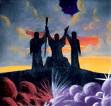
While the Israelites were fihgting the Amalekites under the military leadership of Joshua, Moses, Aaron, and Hur were standing on a hilltop watching the battle.
When Moses raised his hands holding the staff of God, the Israelites prevailed in battle. When Moses' hands grew weary and fell down to his side, the Amalekites prevailed in battle.
Finally, Aaron and Hur placed a large stone for Moses to sit dowm on underneath him and while Moses was sitting Aaron and Hur stood on each side of him and held his arms up. They continued in this way until sundown and Joshua and the Israelite army defeated the Amalekites.
The Amalekites were probably a nomadic people who resided in the area of the Negev on the northern part of the Sinai peninsula and came down to the southern part of Sinai to attack the Israelites. The attack of the Amalekites was particularly offensive because they attacked the weakest Israelites, the stragglers who were at the rear (Deuteronomy 25:17-18).While the Israelites were fihgting the Amalekites under the military leadership of Joshua, Moses, Aaron, and Hur were standing on a hilltop watching the battle.
When Moses raised his hands holding the staff of God, the Israelites prevailed in battle. When Moses' hands grew weary and fell down to his side, the Amalekites prevailed in battle.
Finally, Aaron and Hur placed a large stone for Moses to sit dowm on underneath him and while Moses was sitting Aaron and Hur stood on each side of him and held his arms up. They continued in this way until sundown and Joshua and the Israelite army defeated the Amalekites.
Monday, February 13
God Will Take Notice - Exodus 3:23-25
"The Israelites groaned because of their difficult labor, and they cried out; and their cry for help ascended to God because of the difficult labor. So God heard their groaning, and He remembered His covenant with Abraham, Isaac, and Jacob. God saw the Israelites, and He took notice." Hundreds of years had passed since Joseph was prime minister of Egypt and had urged his father, Jacob, and his brothers to move there. From the original seventy migrants, the Israelites had grown into a huge nation possibly numbering in the millions. The Israelites had become slaves of the powerful pharaohs who ruled Egypt. These pharaohs made great demands upon their Hebrew slaves and so the Israelites began to cry out to God to rescue them from their difficult circumstances. In these verses, four different words for the Israelite outcry and God's corresponding reaction combine to make a powerful statement about God's response to the desperation of His people. God hears, remembers, sees, and takes notice of the predicament of the Israelites. When God takes notice, something happens! Already, God had appointed a rescuer for the Israelites in the person of Moses. And we get an indication of what the exit strategy will be just a few verses later: "Then the Lord said, 'I have observed the misery of My people in Egypt, and have heard them crying out because of their oppressors, and I know about their sufferings. I have come down to rescue them from the power of the Egyptians... The Israelites’ cry for help has come to Me, and I have also seen the way the Egyptians are oppressing them. Therefore, go. I am sending you to Pharaoh so that you may lead My people, the Israelites, out of Egypt'"(Exodus 3:7-10). When we cry out to God in desperation, we can be assured that God takes notice of our situation. Now God may not resolve our problems when we would like or how we would choose, but He will take action and respond at a time and in a manner that will that will help us know Him and His will in a new and better way! "We know that all things work together for the good of those who love God: those who are called according to His purpose" (Romans 8:28).
Sunday, February 5
Living Like It Matters for Eternity - Matthew 25
We live in the time between the first and second comings of Jesus. It's a time when we are joined to Jesus by His Spirit but awaiting his final coming. At His coming we will dwell in His personal presence. When Christ appears for the second time, those in Christ who are dead will be raised and along with those who are living in Christ will be transformed to share in the reality of the new heavens and earth where God personally dwells. So to live effectively and productively in this present age, Christians should be focused on eternity while making the most of the life they have in this present world. Jesus told a number of apocalyptic parables in Matthew 25 that describe what should be our attitude and subsequent behavior regarding the Second Coming of Christ. Each of these parables highlights a particular behavior/attitude we should possess in anticipation of the Apocalypse:
- The Parable of the Ten Virgins is about Vigilance. Ten virgins take their lamps and go to meet the bridegroom. Five are foolish and take their lamps but do not take extra oil with them while five are wise and take oil in jars along with their lamps. When the bridegroom arrives at midnight, the foolish ones have left to go buy oil for their lamps while the wise virgins are ready and are admitted to the wedding banquet. The foolish virgins come later but the bridegroom does not admit them to the wedding banquet. "Therefore, be alert, because you don't know the day or the hour" (vs. 13).
- The Parable of the Talents is about Stewardship. A man leaving on a journey entrusts his property to his slaves, giving five talents of money to one, two to another and one to another, each according to his ability. The slave with five gains five more and the slave with two gains two more, but the slave receiving one hides the money in a hole in the ground. When the master returns and settles accounts with them, the slaves receiving the five and two report they gained the same amount back and the master rewards them accordingly. The slave burying his money returns it and the master rebukes him for not making any interest on his money and gives his one to the slave with ten. "For to everyone who has, more will be given, and he will have more than enough. But from the one who does not have, even what he has will be taken away from him" (vs. 29).
- The Parable of the Sheep and Goats is about Accountability. When Christ the King comes in glory He will judge all nations by separating people one from another as a shepherd separates sheep from goats. He rewards those on his right with co-ownership of His Kingdom because they helped Him when they helped a person in need. He sends those on His left into the eternal fire prepared for the devil and his angels because they did not help Him when they did not help a person in need. "Whatever you did not do for one of the least of these, you did not do for Me either. And they will go away into eternal punishment, but the righteous into eternal life" (vs. 45-46).
Sunday, January 22
Focal Point - Genesis 28:18-22
"Early in the morning Jacob took the stone that was near his head and set it up as a marker. He poured oil on top of it and named the place Bethel...Then Jacob made a vow: 'If God will be with me and watch over me on this journey, if He provides me with food to eat and clothing to wear, and if I return safely to my father’s house, then the Lord will be my God. This stone that I have set up as a marker will be God’s house, and I will give to You a tenth of all that You give me.'" Jacob was on a journey to Haran and at the end of one of the days during his journey he stopped and camped outdoors. That night God appeared to Jacob in a dream of a stairway that started from where he was and reached to heaven. Angels were ascending and descending the stairway. In the dream God transferred to Jacob all the essential elements of the promises He had given to Abraham and Isaac. When Jacob awoke, he took the stone that was near his head and set it up as as a marker or a memorial and anointed it with oil and named the place Bethel, meaning house of God. Then Jacob made the vow stated in these verses. To Jacob the anointed stone was a marker to remind him of the place he had found his focus, his center, his balance, his purpose in life. And now his life was going to be devoted to the One who gave life purpose and meaning. So Jacob marked the spot with a stone so he could always reference this focal point of his life for making life decisions and in setting the boundaries of his behavior. Unfortunately, we often do the reverse. We spend a lot of time in trying to define what the boundaries are instead of in seeking our Center. "Go this way, don't go that way," we command. "This is right and that's wrong, we declare. "Do this, don't do that," we contend. Yet all the while we should be seeking the One who is the way, the truth, and the life. When our focus is on knowing the One who is the Center of our life, then it's much easier to determine what the boundaries for our life are. "But seek first the kingdom of God and His righteousness, and all these things will be provided for you" (Matthew 6:33)
Thursday, January 12
An Offer You Can't Refuse! - Genesis 17:1-2
"When Abram was 99 years old, the Lord appeared to him, saying, I am God Almighty. Live in My presence and be blameless. I will establish My covenant between Me and you, and I will multiply you greatly."
Thirteen years after Ishmael's birth, God appeared to Abram for the second time. In these verses God gives Himself a name--El Shaddai--the meaning of which is unknown, but its translation as "God Almighty" is based on a tradition going back more than two thousand years.
The Almighty God invites Abram to live as one who fulfills God's will, His redemptive plan, and if Abram does it God promises to bless him.
That's an offer you can't refuse!
Thirteen years after Ishmael's birth, God appeared to Abram for the second time. In these verses God gives Himself a name--El Shaddai--the meaning of which is unknown, but its translation as "God Almighty" is based on a tradition going back more than two thousand years.
The Almighty God invites Abram to live as one who fulfills God's will, His redemptive plan, and if Abram does it God promises to bless him.
That's an offer you can't refuse!


